Showing posts with label Outsider Art. Show all posts

Tuesday, August 4, 2009

Rudy Rotter's Museum of Sculpture


"Rudy passed away November 4, 2001, at the age of 88. He was born April 23, 1913, in Milwaukee, Wisconsin. He received degrees from the University of Wisconsin (Madison) and Marquette University (Milwaukee), served in the Army Dental Corps during World War II, and operated a thriving dental practice in Manitowoc until retiring at the age of 74. It wasn't until age 43 that he began making and exhibiting his art. From his earliest experiments with plaster in the mid-1950's to his more recent drawings, made just months before his death, he produced an estimated 17,000 works of art. Many remain housed in his Museum of Sculpture in downtown Manitowoc. The joy expressed when describing his creative process, and the imaginative energy of his artworks have been an inspiration to all who met him."

http://www.rudyrotter.com/pages/aboutrudy.htm

Rudy Rotter's Museum of Sculpture is no longer open to the general public. The three story warehouse which houses the artwork has been deemed structurally unsound. Rudy's wife was kind enough to allow our class access to these works, but with instruction to proceed with caution.

Upon entering the museum, one would think they had just walked into an old antique shop. Long wooden tables were stretched from wall to wall, each covered with hundreds upon thousands of works, large and small. There was truly an overload of objects set before us, one really had to look closely to see each objects beauty.

The main problem with Rudy's work is that there is simply so much. No museum has room for it all. A selection process which would deem one object valuable, and the other not, would seem kind of ridiculous. Each piece represents a thought process by the artist, both conscious and subconscious. To select individual pieces, one would be judging value based on materials and labor alone. It's kind of like saying apple pie is better than just an apple, solely because of the materials and labor involved. While this may translate to pricing values in the grocery market, what place does it have when speaking about art and its values?

With over 14,000 works of art in the museum to chose from, do we select only the intricate and decadent pieces of work, or do we keep some of the apples for their simplistic perfection?

Tuesday, July 21, 2009

Bob Watt


This is the home of Bob Watt, an 86 year old Milwaukee based artist and writer who creates more than he knows what to do with. Upon entering his home one has to first find the narrow pathway through the mounds upon mounds of paintings and sculptures. It was hard to imagine that someone could actually live and work in such a place.

Bob Watt began painting in the late 60's when his sister, an artist, asked him to create an abstract painting of sorts. Bob said that after this piece, "the rest just kind of happened by accident." He claims that his artwork is 99% luck and 1% planning.

In 1993, Bobs luck took a turn for the worst. While out one day, his home caught fire and 900 of his paintings went up in smoke. The fire department said that it was the biggest house fire they had ever seen. This didn't deter Watt's will to create, he saw the event as an opportunity for a new start.

Upon meeting Bob I was struck by his quirky charm and equally delightful attire. His shirt was covered in what looked like homemade decorations and pins, and the pockets were filled with pens and trinkets. He started things off by changing his television station from the weather channel to a pornographic film. He said that there was nothing better to ease the mind than the playboy channel. Despite what he may do in his free time, I think he may have turned on the film just to rouse the crowd. He was most likely laughing inside every time one of the students turned to look at the television instead of listening to him speak openly about art.

Judging from his subject matter, it is accurate to say that Bob holds a strong love for the female anatomy. He claimed that not many people truly appreciated the female form, and that he was one of the few that did. Most of the artwork that Bob produces shows evidence of inspiration from the female form.

While most of the rooms were filled with canvases depicting modified Picasso paintings, in the kitchen lie a stack of over 500 hand bound magazines. These booklets were composed of landscape images with nude photographs of women taken by Bob himself xeroxed on top. It was these booklets that I found most intriguing. Just like his self proclaimed attempts to better Picasso's paintings, Bob has taken these images of landscapes and beautified them with the female figure. His unconventional way of compositing the images together leads me to believe that this idea came from Bob alone, and had little to do with outside inspiration or modern photopshopping techniques. It is something that he may have truly stumbled upon by accident.

Sources:
Miracles of the Spirit


Wednesday, July 8, 2009

Rosemarie Koczy


Rosemarie's haunting images are the result of surviving through two concentration camps during WWII. She was born to Jewish parents Martha Wusthoff and Karl Koczy in 1939, and in 1942 the family was deported to a camp in Traunstein, Germany. At such a young age it is no wonder that the faces of these victims would go on to haunt her.

We worked in the fields every day. I saw the killings, the shavings, the bleachings, the torture and hunger, the cold, typhus, tuberculosis. Death was all around.

Her images often depict twisted bodies surrounded by intense marks of noise and line. The particles of ink resonate her ability to seemingly channel the spirits of the dead, while also materializing her need to wrap the bodies in some sort of burial shroud. Before she began drawing and painting in 1970 she had studied tapestry weaving at Ecole des Arts Décoratifs. Rosemarie insisted that her work always be accompanied with the following statement.

I weave you a shroud.
Ich webe euch ein Leichentuch.
Je vous tisse un linceau.


In 1985, Jean Dubuffet selected her work to represent the inaugural exhibition of the Neuve Invention portion of the Collection de l’Art Brut in Lausanne, Switzerland. At the time of her death in 2007 she had completed over 12,000 ink drawings of holocaust victims. In response to the acknowledgment and inclusion of her work as outsider art, she stated

"I don’t pretend to be an artist. I work every day like a labourer on that collective memory. I am just someone who renders justice."

Sources:
Anthony Petullo Collection
New York Times

Residential Art


As I walked down the streets of Milwaukee in search of some glorious item for my found object assignment, I began to look around with a heightened sense of awareness. The first thing I noticed were the unique homes here in the city. It's a subtle yet refreshing change coming from the monotonous maze like areas of earth toned suburban homes near my parents house in Waukesha.

Not only are the homes here unique in shape and color, but the decor as well. Some litter their front walkway with potted plants, while others strew about strange relics they've accumulated over the years.


I began to think deeply about the idea of home decoration as intuitive art. The simple act of self expression to separate oneself from the community. A marker or five that says, "this is my house, this is me." Why is it that some are called to separate themselves, while others feel the need to camouflage and hide amongst the masses? The above images depict two extreme cases found within the same area in Toronto.

Jimmy Lee Sudduth


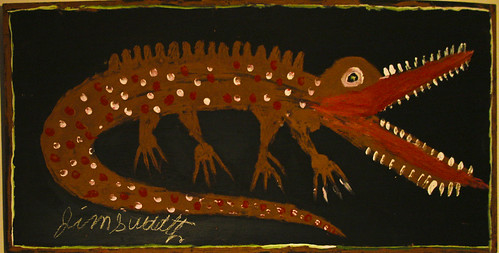
Born on an Alabamba farm in 1910, Jimmy Lee Sudduth's first contact with mud was at an early age. He watched one day as a boy dripped syrup from his mouth, taking notice to the hardened clump of earth which remained the next day. He would go on to use this concoction of clay and sugar to create countless works of art.

Sudduth's earliest memories of creating were at the age of three. He recalled trekking through the forest and leaving marks on all of the trees. After his experience with the syrup, he began mixing different colored clays with sugary substances including syrup, honey, and even Cocacola. This sticky compound allowed him to finger paint the earthy mixture onto makeshift plywood canvases. The sugar not only kept the clay from falling off, but also dried and hardened it in place.

Jimmy's passion for nature manifests not only in his chosen materials but in the subject matter of his art as well. The farm hand loved to paint fish, birds, snakes and alligators. To increase his gamut of colors he would crush leaves, pine needles, and other foliage depending on the season. For red's he would mash up different kinds of berries, and for dark stains he would use coffee beans, and walnut shells. Sudduth claims he could identify 36 different shades of mud, and with the addition of natural additives his color palette was very large.

Despite his love for natural materials, Jimmy couldn't resist when neighbors started leaving buckets of latex paint on his front porch. By 1970 he was using latex paint almost exclusively in his work. Along with other assorted prefab materials such as egg coloring, carpenters chalk, and grease. The paint allowed him to create more and work faster, and that was a good enough reason for him.


In his later years he began drawing rural and city scapes, including homes, town events, and automobiles. Some of these paintings even depicted architectural landscapes of New York, which he may have seen after his work gained exposure and was put on exhibit.

Jimmy Lee Sudduth died in 2007, at the age of 97. The prolific artist outlived two wives and a son. Two years prior in 2005 the Montgomery Museum of Fine Arts held a major exhibition of his paintings.

Once when Jimmy was asked why he used his fingers to paint, Jimmy replied, "Brushes wear out and my fingers don't. When I die, the brush dies too."

Sources:
Web:
Ginger Young Gallery
NY Times
Print

Outsider Art


What is it?

"Art Brut", or "Outsider art", consists of works produced by people who for various reasons have not been culturally indoctrinated or socially conditioned. They are all kinds of dwellers on the fringes of society. Working outside fine art "systems" (schools, galleries, museums and so on), these people have produced, from the depths of their own personalities and for themselves and no one else, works of outstanding originality in concept, subject and techniques. They are works which owe nothing to tradition or fashion.

- Michel Thevoz, Curator of the Collection de l'Art Brut in Lausanne

The term "Outsider Art" was coined by art critic Roger Cardinal in 1972 as the English synonym for Jean Dubuffet's original French term "Art Brut," which loosely translates to "rough art" or "raw art." Both hold connotations of an unadulterated form of self expression. The artwork is generally produced by individuals who have had no training in disciplinary art forms, live outside of a cultured society, and exhibit a relentless drive to create.

Interest arose in this form of art when several psychiatrists began documenting their mental patients work in the early 19th Century. Interest soared particularly in French artist Jean Dubuffet, who with several others, collected the work and created the Compagnie de l'Art Brut in 1948.

Today the term "Outsider Art" has grown to encompass much more than just the works of mental patients, extending to all individuals living outside of modern society, who were born with a divine calling to create. Relying on only their intuition and ingenuity to create these works of pure expression.

Sources:

WEB
Raw Vision
Anthony Petullo Collection
PRINT
Outsider Art: Spontaneous Alternatives, Colin Rhodes